Jamie Munks
The State Journal-Register
As indecision about how to boost the capital city’s drinking water supply dragged on for decades, another community 520 miles southeast of Springfield was also awaiting a reservoir. While it took 30 years to plan and build Lake McIntosh near Peachtree City, Georgia, that lake came into use in 2013.
In Springfield, meanwhile, the proposed backup water supply, dubbed Hunter Lake, just last month got a fresh endorsement from the city council and, after 50 years of discussion and debate, is still awaiting permits.
That half-century of starts and stops has resulted in an increasing cost, with the latest estimate putting the price tag at $108 million, up from $76.7 million in 2005. And if the project does come to fruition, City Water, Light and Power customers could face a rate increase of 50 percent or more.
And while city officials are hopeful that Hunter Lake may finally become a reality, the permitting agencies will ultimately determine if and when the project moves forward in earnest. The proposal also faces its share of opposition from members of the public and one alderman.
Springfield city officials hope that the recent approvals of Lake McIntosh and others elsewhere in the country and recent droughts will trigger the permitting agencies, including the Illinois Environmental Protection Agency and the U.S. Army Corps of Engineers, to view the Hunter Lake application with more urgency.
The Springfield City Council voted 9-1 in July to endorse Hunter Lake as a supplement to the city’s current drinking water source, Lake Springfield, which state water officials have twice labeled “inadequate” to withstand a severe drought. The city announced Friday that it had reached an agreement with the Illinois Department of Natural Resources for the agency to oversee recreational access and manage wildlife habitats at the site. They signed the agreement Saturday at Conservation World at the Illinois State Fair.
But the city still has a number of obstacles to get past in order to see the second lake built. “We’ve made it this far a number of times,” Mayor Jim Langfelder said. “We’re going to put this on the fast track and try to move in that direction.”
Langfelder and Meckes hope the permits can be secured in 12 to 18 months. When it comes to financing the projects, including through possible rate hikes, Langfelder said he would likely hold meetings in each of the city’s 10 wards to promote the proposal.
Engineering firms city leaders have consulted have said the lake could be completed in about six years, allowing about two years for a design phase and two years for construction.
Permitting process
Hunter Lake requires major permits from three different agencies. The Army Corps of Engineers permit, for dredging and filling the body of water, was put on hold in 2010. The city purchased a gravel pit as a possible alternative to a second lake, and the agency advised city leaders to explore that possibility.
The city will need to update its environmental impact statement, noting the current conditions on the land and what effects building the lake would have, before it can get moving again.
Some of the project’s opponents have insisted that it’s because the scientific need for a backup water supply hasn’t been demonstrated. Some have suggested it’s because Springfield city leaders have wavered on Hunter Lake over the years, pursuing alternatives and failing to send a strong message to the agencies that if the city gets its permits, Hunter Lake will indeed be built.
‘Inadequate system’
The Illinois State Water Survey in 1998 and 2011 called Lake Springfield an “inadequate system,” which means there’s a more than 50 percent chance it wouldn’t be able to provide enough water to meet the current demand through a severe drought.
Hunter Lake opponents have questioned whether Lake Springfield is indeed inadequate. They have charged that water demand projections are overstated and have said the city should employ a fresh set of consultants to look at the data. They also believe demand can be managed by changing the rate structure.
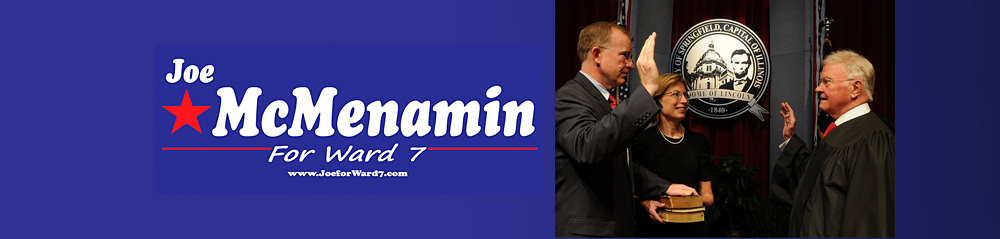
Ward 7 Ald. Joe McMenamin, the only one of the city’s 10 aldermen who voted against the ordinance endorsing the lake last month, said at the time that the city’s supply might be inadequate “once every 100 years.”
McMenamin thinks the city has more pressing concerns.
“We have existing obligations that need to take priority. We’re under enforcement action on our sewers, and we haven’t provided a revenue source for most of that work,” McMenamin said. “We haven’t resolved our electric division financial issues yet, and we haven’t resolved our police and fire pension underfunding, and all of those take priority over an additional water source.”
Several combined smaller initiatives, such as drawing water from gravel pits in the Sangamon River Valley, restructuring rates and offering incentives for using more efficient appliances, could meet the demand, he said.
***
Growing price tag
Planning for a second lake began 50 years ago, and last month’s city council vote was one of at least three backing Hunter Lake that’s passed in that time. A 1988 ordinance, very similar to the recent measure, was approved unanimously. Langfelder’s father, Ossie, was mayor at the time.
Cost is a major factor, and as past city leaders have put off pursuing Hunter Lake, the figure has risen. The city has already spent roughly $26 million on the endeavor and owns roughly 7,000 acres meant for the lake.
Most recent figures peg the cost from this point at $108 million. The cost has continued to grow steadily as construction and labor prices have gone up. A cost estimate in 2003 was $64.2 million, and the estimate grew $12.5 million in two years, to $76.7 million in 2005. Those figures don’t include what the city has already spent on land.
When city officials first started talking about Hunter Lake, the cost estimates were much lower, but many of the environmental regulations the utility must comply with today weren’t yet in place, and environmental impact statements and mitigation requirements such as sewer location weren’t yet mandated, Sabin said.
Water rates for CWLP customers could rise upwards of 50 percent as a result. The monthly residential rate, based on a 5/8-inch meter, is $28. With a 50 percent hike, that would rise to $42, which would put the capital city’s rates higher than Rockford’s and Jacksonville’s. But the rate would still be lower than Chatham, Bloomington, Peoria, Champaign, Decatur, Lincoln and several other Illinois cities.
Last month’s city council endorsement won’t be the only action it takes on Hunter Lake — aldermen will eventually need to OK a financing plan, too. Langfelder said he didn’t want the council to have that discussion at the same time as it was deciding whether to pursue the permits.
 Joe McMenamin for Ward 7