Bruce Rushton
The Illinois Times
Local elected officials due for pensions would have to keep logs showing that they have worked enough hours to qualify for pension benefits under a bill now pending in the state legislature.
That could mean a lot of paperwork for local pols. Elected officials aren’t required to take pensions, but all but one member of the Springfield City Council has signed up for pension benefits and more than half the members of the Sangamon County board are on board.
It’s a matter of keeping politicians honest, says Rep. Jack Franks, D-Woodstock, who is sponsoring the measure that has passed the Senate and is awaiting action in the House. “This isn’t a political issue, it’s a legal issue,” Franks said. “You have a legal obligation, if you’re collecting the benefits, to prove that you deserve them. If you’re not entitled, you don’t get it. It’s very simple.”
In most cases, local politicians must work 1,000 hours a year, which works out to 20 hours per week, to receive pensions. Franks says that’s nearly impossible for part-time elected officials. The Illinois Municipal Retirement Fund also says it’s a tough threshold for part-timers, stating in a online guidance manual that the 1,000-hour threshold can’t be met for members of most governing bodies “barring highly unusual circumstances.”
Nonetheless, eight of 10 Springfield aldermen are signed up for pensions based on working at least 1,000 hours a year; a ninth, Ward 1 Ald. Chuck Redpath, is accruing benefits based on working 600 hours a year, the standard in place when he first became an alderman in 1985. Fifteen of the 28 members of the Sangamon County board are due for pensions.
Franks said he became concerned when he learned that 18 members of the McHenry County board were signed up for pensions. Board members can be required to fill out affidavits swearing that they’ve worked sufficient hours to qualify for pensions, but Franks said that hasn’t been enough. The IMRF is now investigating to determine whether McHenry County Board members deserve pension benefits.
The International Union of Operating Engineers Local 150 recently told the Northwest Herald that the investigation was sparked by a tip from the union, which was upset when the county board last year endorsed the so-called Turnaround Agenda of Gov. Bruce Rauner, who has angered organized labor throughout the state.
After checking minute meetings and other records, Franks said that he determined that one McHenry County board member who had signed up for a pension based on 1,000 hours of annual work had been in meetings for just 90 hours in a single year. Another board member, he said, has bloated her pension by taking a job as an employee for a different county. Under the rules, the board member’s time on the McHenry County board counts under the pension system that will pay out based on a six-figure salary earned elsewhere, making the board member eligible to receive benefits earlier than would otherwise be the case, Franks said.
“Now, instead of making $21,000 (as a county board member), she’s making $100,000, and that’s what her pension’s going to be based on – it’s based on a house of cards,” Franks said. “We’re talking big money.”
Franks said that he’d like to see an outright ban on pensions for part-time politicians. “I don’t think part-time elected officials should be getting fulltime pensions,” Franks said. “Come on – give me a break. It’s two meetings a month.”
Under the rules, politicians can include time spent at community meetings and civic functions as well as time spent talking with constituents and public employees as work time. Elected officials can also claim time spent preparing for meetings. The bill pushed by Franks would require elected officials to write it down. The IRS, he points out, doesn’t allow taxpayers to deduct mileage without receipts or other proof.
Politicians who took office before 2011, when the state tightened benefits, qualify for pensions after eight years in office and can start collecting when they turn 60. Those elected after 2011 must serve at least 10 years and can start collecting when they turn 67. They contribute 4.5 percent of their salary toward their pension, but they can get a refund if they don’t serve the minimum amount of time in office to qualify for a pension. Benefits last for life and include cost-of-living adjustments.
Because payouts are based on years of service and salary, pensions for elected officials are hardly windfalls for most part-time pols.
Former alderman Frank Kunz, who was in office for 12 years, the maximum allowable under city term limits, collected $3,066 in pension benefits in 2014, according to a pension database maintained by the Better Government Association. Springfield aldermen last year earned $15,454, according to the city’s website.
Assuming the salary doesn’t change and an alderman who took office before 2011 remained on the job for eight years, he would receive 13 percent of his salary, or $2,009, during the first year of eligibility to collect. A politician would have to stay in office for 40 years to collect the maximum pension benefit of 75 percent of salary. Due to term limits, an alderman can’t serve more than a dozen consecutive years on the council. An alderman who served that long and signed up before 2011 would be eligible to receive approximately $3,120 per year.
Ward 9 Ald. Jim Donelan is the only member of the Springfield City Council who hasn’t signed up for a pension based on his service as an elected official. Eight aldermen are set to collect pensions based on working 1,000 hours a year; Redpath is due for a pension based on working 600 hours per year, the standard in place in 1985, when he first became an aldermen. First elected prior to term limits taking effect, Redpath served as an alderman for nearly 20 years before leaving office in 2005. He returned to the council in 2014. The city in 1990 adopted the 1,000 hours per year standard.
While he isn’t due to collect a pension as an elected official, Donelan said that it isn’t difficult to work 1,000 hours a year as an alderman. In addition to council meetings, there are lunch meetings, talks with constituents, both scheduled and unscheduled, and hours of time spent to prepare for such big-ticket items as passing budgets and approving coal contracts, he said.
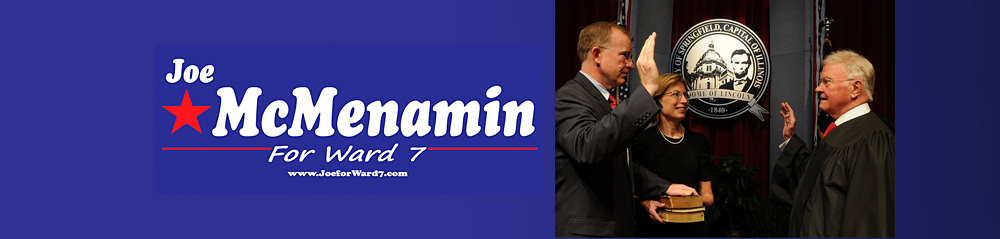
Ward 7 Ald. Joe McMenamin, who has been outspoken about pension costs to the city, said that he didn’t realize when he was first elected in 2011 that pensions for aldermen were optional. He said he signed up as part of a process for new employees that included signing several forms for such things as life insurance.
“It’s one paper after the next to sign,” McMenamin recalls. “I thought it was required.” Nonetheless, McMenamin said he believes that he and other aldermen deserve pensions. He said that he can easily prove he puts in 1,000 a year as an alderman and will compile a log if that’s what the state requires.
“I personally think most aldermen earn it,” McMenamin said. “They’re working 24/7, potentially. You’re on call 24/7 to take any call, to talk about anything someone might want to talk about.”
***
 Joe McMenamin for Ward 7